
By Niamul Haque | SEO & AI Search Optimization Expert
Search is changing. People no longer rely exclusively on traditional search engine results to discover businesses, compare solutions, and make purchasing decisions. They are increasingly using AI-powered experiences to ask questions, explore options, and find relevant information.
From Google AI Overviews and AI Mode to conversational AI platforms, the way people discover brands is evolving.
This shift raises an important question for businesses:
Is traditional SEO still enough, or do businesses need AI Search Optimization as well?
The answer is that businesses should not choose one over the other. Traditional SEO and AI Search Optimization serve different but interconnected purposes. A strong search strategy should combine both to build visibility, credibility, and long-term organic growth.
In this guide, we will explore the differences between SEO and AI Search Optimization, how they work together, and what businesses can do to prepare for the evolving search landscape.
What Is Traditional SEO?
Search Engine Optimization (SEO) is the process of improving a website’s visibility in organic search engine results.
The primary goal of SEO is to help search engines discover, understand, index, and rank relevant website content for searches made by users.
A comprehensive SEO strategy generally includes several core areas:
1. Technical SEO
Technical SEO ensures that search engines can efficiently crawl and understand a website.
Important activities include:
- Improving website crawlability and indexability.
- Optimizing website speed and Core Web Vitals.
- Implementing proper canonical tags.
- Managing XML sitemaps and robots.txt.
- Fixing broken links and redirect issues.
- Implementing relevant structured data.
- Improving mobile usability.
A strong technical foundation is essential for sustainable organic visibility. Businesses can explore my Technical SEO services to understand how technical improvements support website discoverability.
2. On-Page SEO
On-page SEO focuses on optimizing individual web pages to improve relevance and usability.
Common activities include:
- Keyword and search intent optimization.
- SEO-friendly title tags and meta descriptions.
- Logical heading structures.
- Content optimization.
- Image optimization and descriptive alt text.
- Internal linking.
- Entity and semantic relevance.
3. Content SEO
Content SEO involves creating useful, relevant, and well-structured content that addresses the needs of a target audience.
This includes:
- Educational blog articles.
- Service pages.
- Industry guides.
- Product and category content.
- Frequently asked questions.
- Case studies and original research.
4. Off-Page SEO
Off-page SEO focuses on building a website’s authority and reputation beyond its own pages.
Examples include:
- Relevant backlinks.
- Digital PR.
- Industry publications.
- Brand mentions.
- Professional partnerships.
- Relevant industry contributions.
The main objective of traditional SEO is to improve a website’s visibility in organic search results and attract relevant visitors.
What Is AI Search Optimization?
AI Search Optimization is the process of improving a brand’s discoverability, relevance, and representation across AI-powered search and answer experiences.
Traditional search engines typically present a list of relevant web pages. AI-powered search experiences can synthesize information from multiple sources and provide conversational answers with supporting links or references.
Examples of AI-powered search experiences include:
- Google AI Overviews.
- Google AI Mode.
- ChatGPT search experiences.
- Perplexity.
- Other AI-powered discovery platforms.
The goal is to make your brand and content easier for these systems to discover, understand, evaluate, and potentially reference when answering relevant questions.
AI Search Optimization involves several interconnected practices.
1. Entity Optimization
Search systems need to understand who your business is, what it offers, and how it relates to a particular industry.
Entity optimization helps establish clear connections between:
- Your brand.
- Your products and services.
- Your industry.
- Your expertise.
- Your location, where relevant.
- Other relevant entities.
Consistent business information and clear website content help establish a more understandable brand identity.
2. Semantic Content Optimization
AI-powered search systems need to understand the meaning and context of information.
Semantic content optimization focuses on:
- Covering topics comprehensively.
- Explaining concepts clearly.
- Connecting related topics.
- Addressing specific user questions.
- Providing relevant examples.
- Using accurate terminology.
Instead of focusing exclusively on individual keywords, the goal is to communicate complete and meaningful information.
3. Answer Engine Optimization (AEO)
AEO focuses on making content useful and understandable for answer-oriented search experiences.
Practical approaches include:
- Providing direct answers to important questions.
- Using descriptive headings.
- Explaining complex topics in simple language.
- Including relevant examples.
- Structuring information logically.
- Supporting claims with credible sources.
4. Generative Engine Optimization (GEO)
Generative Engine Optimization focuses on improving the visibility and representation of content and brands in generative AI experiences.
It involves building useful, distinctive content, establishing brand credibility, strengthening topical relevance, and making information accessible to search systems.
GEO should not be treated as a collection of shortcuts or guaranteed citation techniques.
The foundation remains useful information, technical accessibility, clear brand identity, and genuine expertise.
Learn more about my approach toGenerative Engine Optimization (GEO)
SEO vs AI Search Optimization: Key Differences
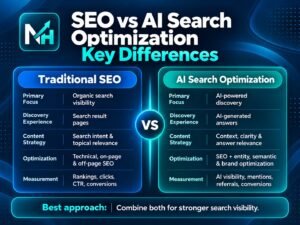
Although SEO and AI Search Optimization share many foundations, their strategic objectives and measurement approaches are not identical.
| Area | Traditional SEO | AI Search Optimization |
| Primary Focus | Organic search visibility | AI-powered discovery and visibility |
| Discovery Experience | Search result pages | AI-generated answers and conversational search |
| Content Strategy | Search intent and topical relevance | Context, usefulness, clarity, and answer relevance |
| Optimization | Technical, on-page, off-page SEO | SEO foundations plus entity, semantic, and brand optimization |
| Visibility | Organic rankings and search impressions | AI references, mentions, and supporting links |
| Measurement | Rankings, clicks, CTR, conversions | Available AI visibility data, referrals, mentions, and conversions |
| User Journey | Search, click, explore | Ask, discover, compare, and potentially visit |
The distinction is important, but these strategies should not operate independently.
Traditional SEO creates a strong foundation for discoverability. AI Search Optimization extends that strategy to emerging search and discovery experiences.
Why Businesses Need Both SEO and AI Search Optimization in 2026
Search behavior is evolving, and businesses need to adapt their digital visibility strategies accordingly.
Here are five reasons why combining both approaches makes sense.
1. Customers Are Discovering Brands Through Different Search Experiences
A potential customer might search Google for a service provider, ask an AI platform to compare available solutions, and then visit a company’s website before making a decision.
This creates multiple opportunities for brand discovery.
Businesses that focus exclusively on one discovery channel may overlook other relevant opportunities.
2. Organic Search Remains an Important Foundation
AI-powered search does not eliminate the importance of traditional SEO.
Google’s documentation explains that its AI search experiences continue to rely on foundational search and technical requirements. Pages generally need to be indexed and eligible to appear in Google Search to be considered for supporting links in these experiences.
According to Google’s official documentation on AI features in Search
businesses should continue focusing on the following:
- Technical SEO.
- Helpful content.
- Website accessibility.
- Internal linking.
- Search intent optimization.
- Overall website quality.
This means businesses should strengthen their existing SEO foundations rather than abandon traditional optimization.
3. Brand Credibility Matters Beyond Rankings
Visibility is not simply about appearing in search results.
Customers also need reasons to trust a business.
A credible digital presence can be strengthened through:
- Detailed service information.
- Consistent brand identity.
- Genuine customer testimonials.
- Original research and insights.
- Relevant industry contributions.
- Author expertise and transparent business information.
These elements help users evaluate a business and provide clearer context about its expertise.
4. Comprehensive Content Creates More Discovery Opportunities
A website that only targets commercial keywords may miss many informational questions that potential customers ask before choosing a service provider.
For example, an SEO agency could create content covering:
- What is technical SEO?
- How does local SEO work?
- What is Generative Engine Optimization?
- How do Google AI Overviews work?
- What is the difference between AEO and GEO?
- How can businesses improve organic search visibility?
These topics support different stages of the customer journey and create opportunities to connect educational content with relevant services.
5. Businesses Can Build a More Resilient Search Strategy
Depending entirely on a single traffic source can create unnecessary risk.
A more comprehensive strategy combines:
- Organic search visibility.
- AI-powered discovery.
- Brand awareness.
- Referral traffic.
- Industry authority.
- Direct audience relationships.
The objective is not to abandon traditional search. It is to expand the ways potential customers can discover and evaluate your business.
How to Combine SEO and AI Search Optimization: A Practical Framework
Businesses do not necessarily need two separate optimization strategies.
Instead, they can build one integrated framework.
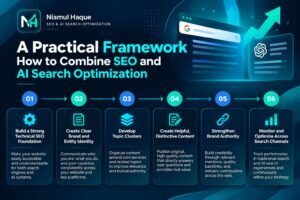
Step 1: Establish a Strong Technical SEO Foundation
Start by ensuring that search engines can access and understand your website.
Review:
- Crawlability and indexability.
- Website architecture.
- Internal linking.
- Page experience.
- Mobile usability.
- Canonical implementation.
- Structured data accuracy.
Without a technically accessible website, other optimization efforts may have limited value.
Step 2: Build a Clear Brand and Entity Identity
Your website should communicate exactly who you are and what your business does.
Make sure your:
- About page explains your expertise.
- Service pages describe your actual offerings.
- Author information is accurate.
- Business details remain consistent.
- Brand profiles are maintained.
- External references are relevant and authentic.
Step 3: Develop Topic Clusters
Organize content around your core services and areas of expertise.
For example:
SEO Topic Cluster
- Technical SEO.
- On-Page SEO.
- Local SEO.
- E-commerce SEO.
- SEO Audits.
AI Search Optimization Topic Cluster
- Generative Engine Optimization.
- Answer Engine Optimization.
- AI Search Visibility.
- Entity Optimization.
- Semantic SEO.
Each topic should connect naturally to relevant supporting articles and service pages.
Step 4: Create Helpful, Distinctive Content
Avoid publishing content simply to target more keywords.
Instead, create resources that offer meaningful value.
Include:
- Original insights.
- Practical explanations.
- Real-world examples.
- Expert analysis.
- Supporting evidence.
- Clear answers to user questions.
Content should demonstrate genuine knowledge rather than simply repeat information available elsewhere.
Step 5: Strengthen Relevant Brand Authority
Build your reputation through meaningful contributions to your industry.
Consider:
- Publishing expert articles.
- Participating in relevant professional discussions.
- Contributing to industry publications.
- Sharing original insights on LinkedIn.
- Creating educational videos.
- Building authentic professional relationships.
Prioritize relevance and credibility over artificial mentions or mass-produced links.
Step 6: Measure Performance Across Search Channels
Traditional SEO performance and AI search visibility should be evaluated using appropriate metrics.
For traditional SEO, monitor:
- Organic clicks.
- Search impressions.
- CTR.
- Average position.
- Organic conversions.
- Indexed pages.
For AI search, monitor available data such as:
- AI referral traffic.
- Brand mentions.
- Relevant AI-generated references.
- Referral conversions.
- Brand search growth.
- Qualified leads.
Not every AI platform provides complete visibility or citation data. Therefore, avoid treating any single third-party visibility score as a complete representation of performance.
Common AI Search Optimization Mistakes Businesses Should Avoid
As interest in AI Search Optimization grows, many businesses are exposed to misleading promises and unnecessary tactics.
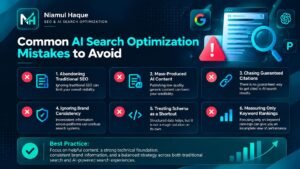
Avoid these common mistakes:
1. Abandoning Traditional SEO
AI search does not make technical SEO, content quality, or search accessibility irrelevant.
2. Publishing Mass-Produced AI Content
Producing large volumes of generic content without adding expertise or original value is not a sustainable content strategy.
3. Chasing AI Citations With Guarantees
No consultant can honestly guarantee that a specific brand will appear in every AI-generated answer.
4. Ignoring Brand Consistency
Conflicting information across websites, professional profiles, and business listings can make it harder for users to understand a brand.
5. Treating Structured Data as an AI Ranking Shortcut
Structured data can help search engines understand page content, but there is no special schema markup that guarantees inclusion in AI-generated answers.
6. Measuring Only Keyword Rankings
Rankings matter, but businesses should also evaluate leads, conversions, brand discovery, and the quality of incoming traffic.
The Future of Search: Why an Integrated Strategy Matters
The future of search is not simply about ranking a webpage for a keyword.
People are using different platforms and experiences to research products, discover businesses, compare services, and make decisions.
Traditional search engines remain important, while AI-powered discovery is creating additional ways for people to find information.
Businesses that invest in strong SEO foundations, useful content, clear brand identity, and genuine expertise will be better positioned to adapt to these changes.
Rather than treating SEO and AI Search Optimization as competing disciplines, businesses should approach them as complementary parts of a broader digital visibility strategy.
Final Thoughts
SEO is not disappearing. Search is expanding.
Traditional SEO helps businesses improve their visibility in organic search results. AI Search Optimization extends the focus to how brands and their information can be discovered across AI-powered search and answer experiences.
Both require useful content, technical accessibility, clear information, and a strong understanding of user intent.
As an SEO & AI Search Optimization Expert, I believe businesses should focus on building a sustainable search presence rather than chasing short-term optimization trends.
The goal is simple: Help your business get found in search, get understood by AI, and build visibility that supports long-term growth.
If your business is looking to improve its organic search presence or prepare for the evolving AI search landscape, a well-planned SEO and AI Search Optimization strategy can be a valuable starting point.Explore my SEO services or get in touch to discuss your search visibility goals.
Frequently Asked Questions
Is SEO still important in the age of AI Search?
Yes. Traditional SEO remains important because search engines still need to discover, crawl, index, and understand website content. Strong SEO foundations also support discoverability across evolving search experiences.
What is the difference between SEO and GEO?
SEO focuses on improving website visibility in traditional organic search results. GEO focuses on improving content relevance, clarity, and discoverability in generative AI search experiences. Both approaches are complementary.
Does AI Search Optimization replace traditional SEO?
No. AI Search Optimization builds on traditional SEO foundations. Technical accessibility, helpful content, search intent, and website quality remain important.
How can a business improve its AI Search visibility?
Businesses can focus on publishing useful and distinctive content, improving website structure, strengthening topical relevance, communicating brand expertise clearly, and maintaining a technically accessible website. No particular tactic guarantees AI citations.
How long does AI Search Optimization take to show results?
There is no universal timeline. Results depend on website quality, competition, content coverage, brand recognition, technical accessibility, and the AI platforms being evaluated. Consistent improvements and ongoing measurement are important.
About the Author
Niamul Haque is an SEO & AI Search Optimization Expert with five years of experience in search optimization. His professional focus includes Technical SEO, Content Strategy, Generative Engine Optimization (GEO), Answer Engine Optimization (AEO), and AI Search Visibility.
He shares practical insights to help businesses strengthen their search presence and adapt to the evolving digital discovery landscape.